

I like theoretical models like the constructivist approach because students have to build their knowledge through discovery and social interaction. However, sometimes a learner just needs to sit there and be explicitly taught how to do something. I knew there had to be approaches like this out there when it came to instructional design, and was intrigued when I saw cognitive apprenticeship on the list of instructional design models. I don’t hear much about apprenticeships anymore, but I’m sure they exist in certain lines of work. In fact, my dad was an apprentice when he went into tailoring 40ish years ago.
I’ll need to ask my dad what his apprenticeship entailed, but Stalmeijer (2015) indicated that a basic apprenticeship involved observation on the learner’s part. What’s interesting in the cognitive approach is that the instructor specifically goes through their thought process (even at the meta-cognitive level) while showing a student the steps in a task. After that, the student performs the task as the instructor coaches them with scaffolding. Then, the student articulates their thought process as the instructor did and reflect on their progress and set learning goals.
Instructional design models are the process the designer goes through to create and implement instruction. The ADDIE model
(analysis, design, development, implementation, evaluation) is the one I’ve heard about the most while pursing my degree in instructional design, and, to me, makes a great deal of sense. Theoretical models, on the other hand, are more about HOW students learn.
I had a hard time figuring out how cognitive apprenticeship was considered an instructional design model, because it seemed more like a theoretical model. As it turns out, the article I was reading had a second page that showed up when I viewed it in PDF form, and that extra information was what I needed! The other page discussed how the instructor sequenced the learning activities and used real-world examples to engage students.
It makes more sense now, because I see flow of instruction. However, if I were a client, I think I would still struggle to perceive cognitive apprenticeship as a design model and not also a learning theory. In fact, I Googled it because I was still a bit confused. Based on the list of results, cognitive apprenticeship is, in fact, a learning theory AND a design model.
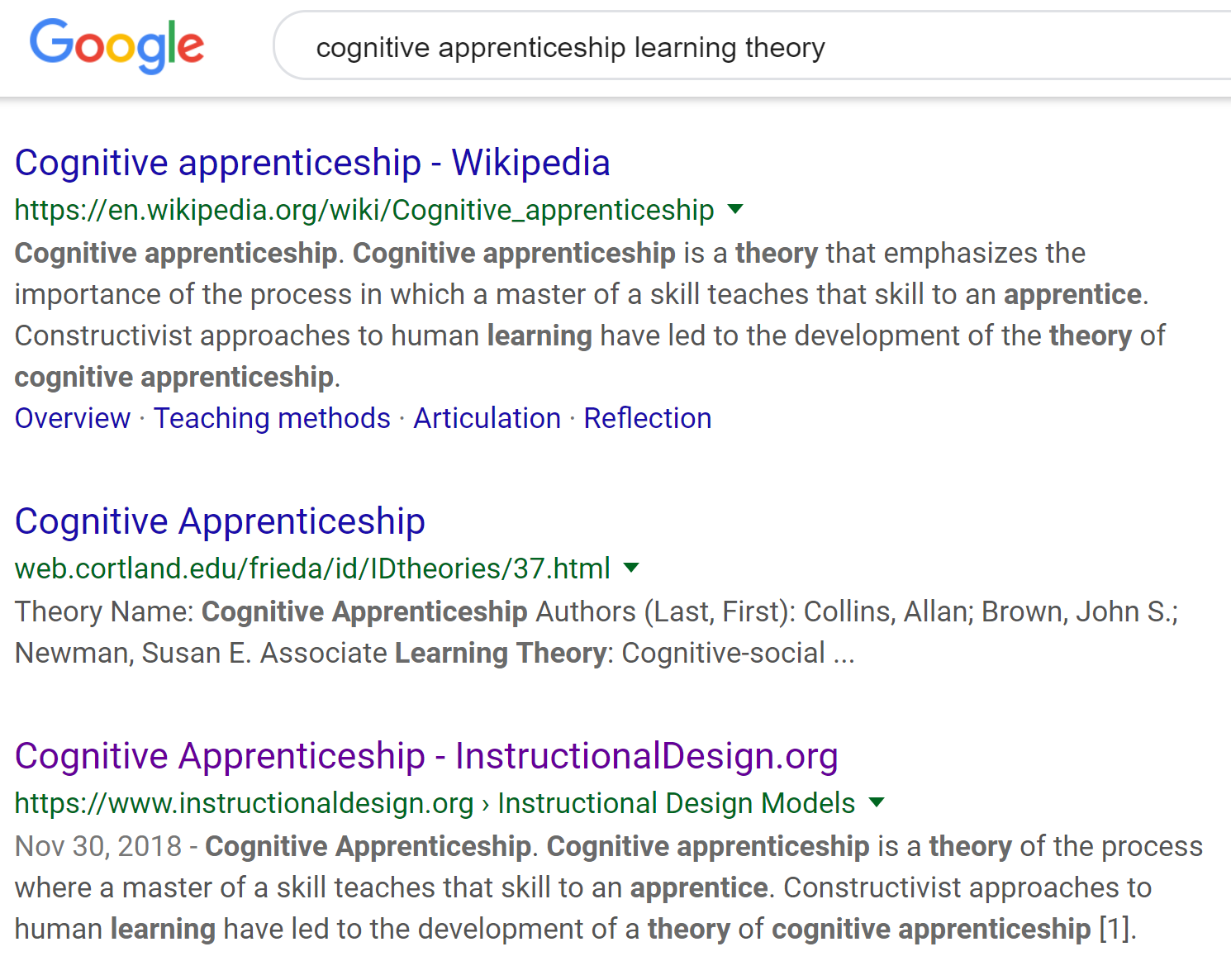
If I were trying to explain the difference between an instructional design model and a learning theory to a client, I would not use cognitive apprenticeship as an example. I would stick to something like ADDIE and constructivism because it’s much easier to differentiate between the two.
I still think cognitive apprenticeship is a great learning theory/model, and is especially useful for those learning a trade. I will definitely remember it for future assignments.
References:
Stalmeijer, R. E. (2015). When I say … cognitive apprenticeship. Medical Education,49(4), 355-356. doi:10.1111/medu.12630
 Laura Carr LTEC 5510