Okay…So it’s not done…

I did not include rubrics in my original design because I figured “Hey, they’re all adults. They can follow directions.” The more I thought about it, the more I realized it’s probably a good idea to avoid confusion. The goal of my class is for everyone to be successful, so they’ll have opportunities to fix assignments they don’t do well. This way, the instructor will at least have a check list, because there’s a rubric feature built-in to Canvas. Also, I sent our librarians an email and asked them to click on a link to fill out a form to respond to something, and half of them emailed me back. So, maybe, I can’t trust adults to always follow directions…

I feel a little stressed because now I have to go back and add all those. I also realized that I need to update my design document because I’ve changed things in the course after it was “finished.” I’m also confused, because I’m basically reiterating my design document in my job aid (along with all the other job aid bells and whistles), but we are supposed to post both. I don’t know if that means I’m going over too much in my job aid, or if there’s another reason.

I’ll finish in time. I’m not worried about that. I’m a perfectionist, so I just hope at some point I can stop messing with it and consider it done.

I’ll get to implement this next year, so I’m excited to see how it goes. The curriculum coordinator for the librarians even approved it for Gifted/Talented credit, so I’m hoping that will entice more librarians to actually take the course. I’ll be there too, and will most likely be the facilitator, so I’ll have the firsthand experience of how it went.

It’s Done…I Think

I’m still waiting to hear back about my final peer review, but everything is good to go as far as I know.

Honestly, I didn’t have any issues getting this course put together in time. Since it’s a subject I’m very passionate about, I already knew where to find a lot of the material and which direction I needed to take. I haven’t run into any issues with the technology either, as I’m fortunate enough to already be familiar with Canvas.

I would say the “people” issues are the ones that have given me the most challenges, in that I have to keep changing my activities to best fit the people taking the course. First, it was only aimed at new librarians, but now it’s been redesigned to serve both new and experienced librarians. I also went back and made it more visually appealing throughout the process so that they would enjoy it more.

I feel like future design projects won’t be this easy, especially if I’m not the subject matter expert. I don’t want to be overconfident and assume all the others will go off without a hitch. I think there will also be the added pressure of having to do it for someone else, and making sure that I’m meeting their needs and communicating correctly. Getting paid to do something makes you worry about doing it correctly on a whole different level.

Since I work with my audience as part of my job, I feel like I designed the course around their needs and what they’ll be able to handle in terms of workload. The course guides them, but never tells them what they “right” makerspace design is, which, to me, is important. I want them to create their space based on their needs and environment, and I think I’ve done a good job of that.

When compared with other courses, I’m afraid it looks a bit “blah.” I don’t have lots of fancy graphics or videos, but I didn’t really feel it was necessary as I designed it (since my goal was to cut out all the “fluff”). As I reflect back, there may have been ways for me to incorporate some more visual examples or even Tweets from other makerspaces. I didn’t want to lock them into a certain design by sharing those examples, but maybe they would have helped. Hopefully I’ll get some good feedback. Second-guessing yourself is the worst feeling.

3/4 Done!

I’ve had my content loaded into my modules for quite some time. It would be easy to just say I’m done and leave it at that, but I’m too much of a perfectionist. I’m actually glad that it gives me time to not look at things for a while, because when I go back and look at it with fresh eyes I always find something to improve.

For example, I noticed my formatting was, well, pretty non-existent. Everything was just boring. Visual appeal is important and proper formatting helps to break information up for the brain. Since I just learned this last semester in the graphic design class, I figured it would be a good idea to actually APPLY those principles. I used a coordinating color and made subheadings for each section so there was some separation for new and existing librarians.

*Side note* Did you know that, if you’re making subheadings in Canvas, you need to actually use the subheading feature instead of just changing the font size? This meets the standards for ADA, because screen readers do different things for subheadings and don’t do that for different font sizes. A district nearby got in major trouble for not meeting ADA policy, so we’ve been having to be extra careful with what we do so we don’t meet the same fate.

As far as what I still need to do, I just need to keep looking back at things with fresh eyes and improve where I can. My peer reviews have been incredibly helpful, so I’ll take those into account too. I didn’t hear anything back from posting my video, but it was probably because I submitted the wrong link and nobody was able to view it. By the time I corrected it, nobody was looking anymore.

I’m confident that I’ll be finished in time, because I basically already am. At this point, it’s all fine tuning. I will be implementing this class next year for our librarians, and I’ve already had a request from another district to share it in commons so they can use it with their librarians as well! I’m not going to lie…I was pretty excited when I saw that email. I had been discussing it with another EdTech at a blended learning academy I’m attending at Region 11, and she seemed very excited about it. I told her I’ll make sure she gets it by the end of the school year.

I’ve kept my evaluation simple. I don’t feel like I need loads of data to determine whether the class is helpful, so I’m keeping the evaluation short and sweet. I may go back and tweak some of the questions as I go, so it’s not in its final draft.

Morgan Freeman meme saying that we are almost done

Halfway There!

So far, my feedback has been phenomenal. It’s nice to have another educator’s perspective, and it’s even nicer when they give ACTUAL feedback about content.

Rob pointed out a few typos and wording issues I had, which are truly horrifying things to a former language arts teacher. They will be fixed immediately. He also gave me a great idea of how I can tweak one of the assignments to make better use of our seasoned librarians. Additionally, he suggested I hide most of the navigation options on the side bar, as they aren’t being used. I had actually planned on doing that, but I’ve just been putting it off to focus on the content.

Speaking of things I’ve put off, I’ve finally started adding some images as headings into the course to jazz it up. I’m using a Lego-themed image because it relates to makerspaces and it just seems to cheer things up a bit and break up some of the text. I’ve been debating about making something similar to separate the activities for current and new librarians, but I haven’t decided if I want to get that crazy with it yet. I don’t want to overdo it or make it look too juvenile, especially since the course audience is adults.

Dr. Faulkner said that the average corporate ID project only lasts three weeks. Since we are in week eight of our course, we’ve clearly worked at a much slower pace. I feel like I had the course planned out and uploaded by week three, but it’s taken all of these other weeks to refine it with feedback and really make it better. I probably would have had an “acceptable” course at three weeks, but I think we are all aiming to do better than that.

I’m curious if the three week timeline also applies to instances when the designer is not the content expert. It seems like it would be hard to make that work when you’re trying to meet with the content expert and get all of that coordinated with your design. Then again, I’ve only ever done this as homework; I’m sure it’s different if it’s all you’re doing all day long and have the company resources at your disposal.

Image result for ready for spring break meme

Time to Revise

I got some good feedback about my design document from both Dr. Faulkner and Rob, so I feel like I have a good idea of where I need to head next.

The biggest issues I needed to address were my learning goals and objectives. Dr. Faulkner pointed out that many of my objectives were actually activities. Once I went back and took a good hard look at them, I realized that one of my goals was superfluous because all of its objectives were already met elsewhere. I deleted that goal, and adjusted the other objectives so that they were actually objectives (I hope). I’ve struggled with differentiating between the two since my first instructional design class, so I’m hoping I’ll continue to get better at it.

It was also pointed out that a few of my modules probably didn’t have enough content to meet the 40-hour requirement. I went back in and added a few more activities to round them out, which I probably needed to do regardless of the length requirement. I think it’s long enough now, and probably more complete.

I don’t feel like the design of the LMS has hindered my design. I have experience with Canvas, so I had more of an idea going in of what layout things would have and how to achieve them. I’ve already built out the course, so now I need to go back in and add the new material. It was great having a little bit of the stress taken off because I worked ahead, but now it’s back to the grindstone. I like the images Rob added to his course to break up the text and act as headers, so I think I might try to do something similar to jazz things up a bit. Right now, it’s just a bit boring.

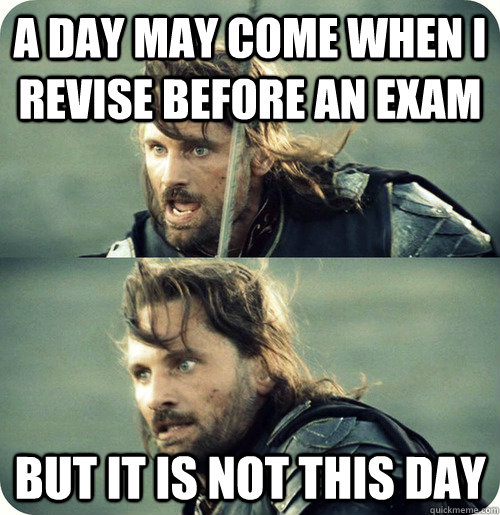
Side note: I love to include memes with things when I can. I went online to see what was already out there about revising your work. Apparently, “revising” basically means studying in British English. So, for fun, I’ll include some here to enhance your cultural experience for the day.

Edit: Wow. I just realized both of the ones I picked were from Lord of the Rings. Not sure if that says more about how well the saga lends itself to memes, or my subconscious….

Let the building commence!

I emailed my design documents to the librarians in our district and asked for feedback. I wanted to know if I had missed something a seasoned librarian thought was important. The feedback I received was all positive, and a few librarians said that they couldn’t wait to take the course themselves. Since I had originally designed the course to be for new librarians, that response was surprising; I had assumed librarians would be insulted if I asked them to take a course over something they had already done.

With that in mind, I changed the course to be both for new and current librarians. I kept the original activities I had created, and created alternative ones for current librarians to complete in each module. I think having the mix of seasoned and new perspectives in the discussion boards will offer more depth to the conversations being had. Plus, the new activities I made for the current librarians will (hopefully) help them to grow and improve their makerspaces.

As far as building the course in Canvas, I’m at a bit of an advantage. I used to use Canvas when I was a classroom teacher, and I help build course content for our district in my new job. I had some free time when I was home with a sick infant (and a sick me), so I was able to build out the entire course for the most part. I still need to create the course survey at the end and restrict the navigation options that students see to just home, announcements, modules, and discussions, as I feel that having anything else up there causes too much confusion, but I can do that later. I wanted to wait for more feedback before I “finalized” anything.

Since this course is ungraded, I’m offering professional development credit instead. In order to receive it, librarians must complete all of the activities on time. I’m wondering how to enforce this or what would happen if they don’t complete the activities, so I need to figure that out before I make my job aid.

Peer feedback won’t happen until next week, so I’m just in limbo until then. I feel good about what I’ve created so far, so I’m hoping things will continue to go smoothly. My daughter keeps picking up bugs from daycare and spreading them to my husband and me, so I’m trying to get as far ahead as I can for when I inevitably get sick again.

Cognitive Apprenticeship

I like theoretical models like the constructivist approach because students have to build their knowledge through discovery and social interaction. However, sometimes a learner just needs to sit there and be explicitly taught how to do something. I knew there had to be approaches like this out there when it came to instructional design, and was intrigued when I saw cognitive apprenticeship on the list of instructional design models. I don’t hear much about apprenticeships anymore, but I’m sure they exist in certain lines of work. In fact, my dad was an apprentice when he went into tailoring 40ish years ago.

I’ll need to ask my dad what his apprenticeship entailed, but Stalmeijer (2015) indicated that a basic apprenticeship involved observation on the learner’s part. What’s interesting in the cognitive approach is that the instructor specifically goes through their thought process (even at the meta-cognitive level) while showing a student the steps in a task. After that, the student performs the task as the instructor coaches them with scaffolding. Then, the student articulates their thought process as the instructor did and reflect on their progress and set learning goals.

Instructional design models are the process the designer goes through to create and implement instruction. The ADDIE model
(analysis, design, development, implementation, evaluation) is the one I’ve heard about the most while pursing my degree in instructional design, and, to me, makes a great deal of sense. Theoretical models, on the other hand, are more about HOW students learn.

I had a hard time figuring out how cognitive apprenticeship was considered an instructional design model, because it seemed more like a theoretical model. As it turns out, the article I was reading had a second page that showed up when I viewed it in PDF form, and that extra information was what I needed! The other page discussed how the instructor sequenced the learning activities and used real-world examples to engage students.

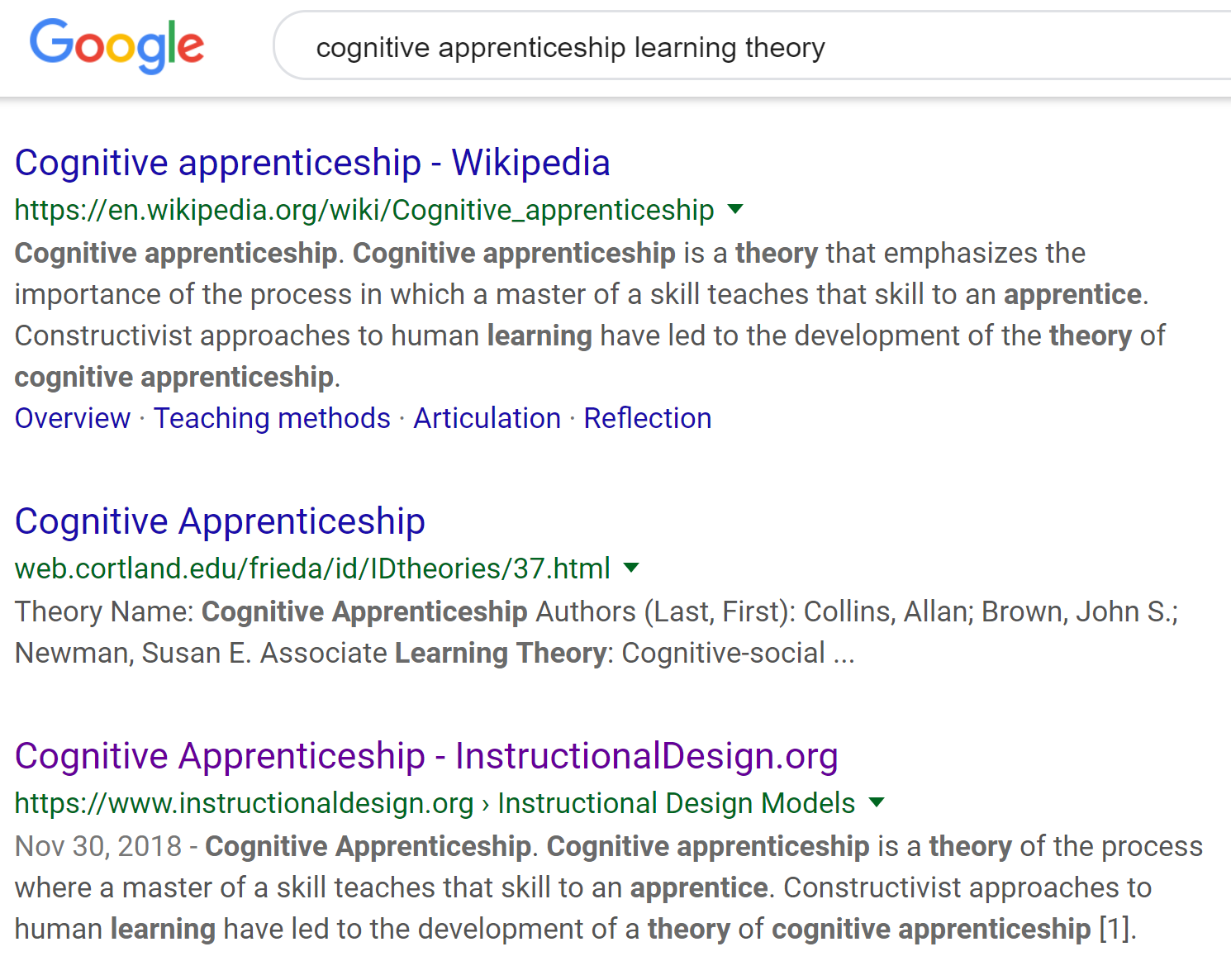
It makes more sense now, because I see flow of instruction. However, if I were a client, I think I would still struggle to perceive cognitive apprenticeship as a design model and not also a learning theory. In fact, I Googled it because I was still a bit confused. Based on the list of results, cognitive apprenticeship is, in fact, a learning theory AND a design model.


If I were trying to explain the difference between an instructional design model and a learning theory to a client, I would not use cognitive apprenticeship as an example. I would stick to something like ADDIE and constructivism because it’s much easier to differentiate between the two.

I still think cognitive apprenticeship is a great learning theory/model, and is especially useful for those learning a trade. I will definitely remember it for future assignments.

References:

Stalmeijer, R. E. (2015). When I say … cognitive apprenticeship. Medical Education,49(4), 355-356. doi:10.1111/medu.12630

First Peer Review

The reviews are in! I am so relieved to FINALLY have a professor that takes the time to give feedback and answer questions, in a course that’s reflective of what we are supposed to be learning. It’s a refreshing change of pace to be actually learning the material instead of wondering what the heck is going on.

Ranting aside, I found the review process to be extremely helpful. After spending so much time with a document, my brain starts to gloss over the errors. To me, it’s Shakespearean perfection, and I need fresh eyes to give me a reality check.

My peer review buddy, Rob, pointed out a few places where my wording was vague and needed some clarification, and even found some errors where I forgot to remove some information when I changed the type of audience. He also suggested I add some citations about why makerspaces are important to the document to add an extra level of oomph to the justification section. I think the fact that the district requires a makerspace is justification enough, so I’m not sure how much, if any, I’ll add to that section.

While I originally said this course was only for new librarians as they designed their makerspaces, he challenged that notion and suggested that it could be for current librarians as well. While the focus will continue to be for incoming librarians, I think I will say that current librarians would have the option to work through it for PD credit, too. Even though their makerspaces are established, going through the process might give them some insight on areas they could improve. Furthermore, I thought it would be a good idea to have some current librarians volunteer to participate in the discussion boards, so that the incoming librarians would have feedback and perspective from someone already in the trenches.

My ultimate goal is to have a class our district can actually use for incoming librarians. I mentioned that I was working on this to my boss, and she suggested I get feedback from actual librarians in the district as well. I haven’t decided if I’m going to send out my design document, because I don’t know that people will actually take the time to read the whole thing. I may instead ask for general feedback about what they would have liked guidance on when they were getting started, and use that information to tweak the document as necessary. I’ll see what I can get before the final version is due.

Constructivism, Problem-Based Learning, and Librarians as Instructional Designers

Week 1

It’s interesting how my responses to reading about learning theories have changed as I have progressed through this course of study and had new experiences in my professional life. To me, constructivism always seemed like a good idea, but, as a language arts teacher bogged-down under the weight of STAAR testing pressure, I struggled to see how it would be relevant in my class. I didn’t see how students could work to construct knowledge when they needed to be able to understand what they read and answer questions about it.

Now that I’m out of the classroom as an EdTech Trainer, I get to see other examples of how constructivism applies to education. One big way I see is through makerspaces. In their paper, Savery and Duffy (2001) discuss constructivism as it relates to problem-based learning (PBL). When they discuss the principles of constructivism, they talk about how we learn from interacting with our environment, how questions serve as our stimulus for learning, and how collaboration is key to make sense of what we “know.” I realized that all of this takes place as students explore in makerspaces, because it’s an opportunity for them to learn through doing. I’ve always been fascinated with makerspaces, and now I feel like I have a deeper understanding of how learning takes place.

In an educational setting, makerspaces can simply be an environment for students to explore and tinker with both low- and high-tech tools to learn. Blackburn (2016) discussed the importance of students entering the workforce with skills such as critical thinking, communication, and problem-solving, and how traditional teaching techniques often don’t foster these skills. His study investigated taking a PBL approach to education, and, for the most part, students found this approach to be beneficial to their learning. This also applies to makerspaces, because librarians (or educators that bring their students to the space) can use the tools available to construct PBL activities. I hope to investigate this further.

I also hope to investigate how librarians can use learning management systems (LMS) to include online instruction as part of their makerspaces. It would be quite difficult for a librarian to be a subject-matter expert for every tool and activity available in their makerspace, so providing students with opportunities to get the required instruction in how to use these tools using an LMS would not only take the pressure off of librarians, but also give them more opportunities to supply their students with a broader base of knowledge. Furthermore, they could provide PBL challenges using this LMS for students or teachers that want more of a challenge. As Summey and Valenti (2013) pointed out, librarians are not necessarily trained to design instruction, so it would be important for someone like me to get them started using an online platform. Then, they would need to collaborate with other teachers and follow a model like ADDIE in order to design effective instruction.

References

Blackburn, G. (2016). A university’s strategic adoption process of an PBL-aligned eLearning environment: An exploratory case study. Educational Technology Research and Development,65(1), 147-176. doi:10.1007/s11423-016-9472-3

Savery, J. R., & Duffy, T. M. (1995). Problem based learning: An instructional model and its constructivist framework. Educational Technology, 35, 31–38

Summey, T. P., & Valenti, S. (2013). But we don’t have an instructional designer: Designing online library instruction using ISD techniques. Journal of Library & Information Services in Distance Learning,7(1-2), 169-182. doi:10.1080/1533290x.2012.705630